
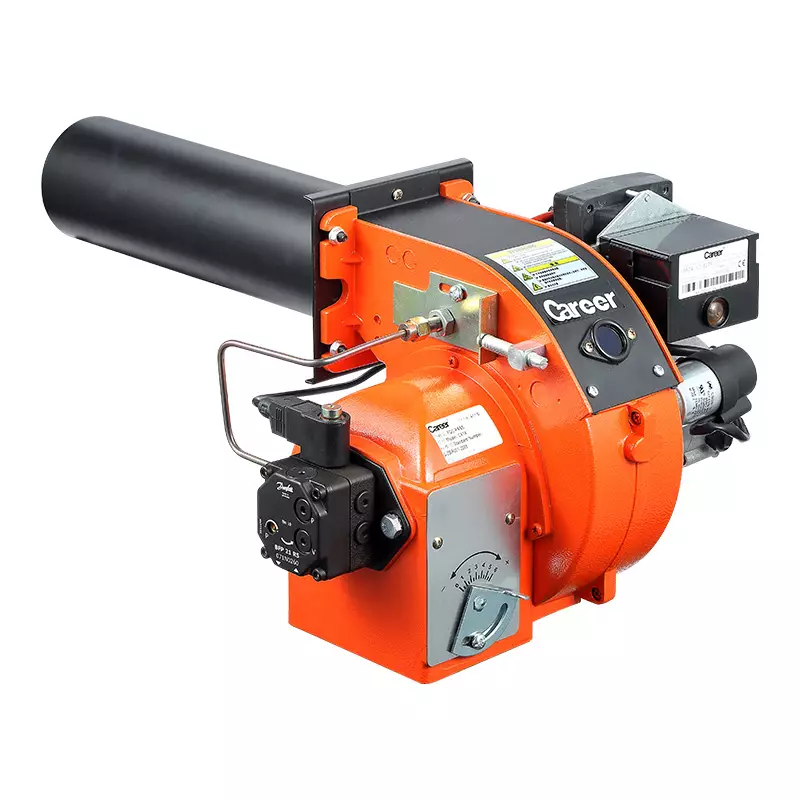
An oil burner can consume the same fuel as a conventional model yet deliver a different heating result. The difference is largely determined by how effectively the burner converts fuel energy into usable heat. For industrial users, efficiency therefore involves more than fuel consumption alone. Atomization quality, air delivery, ignition, flame supervision, and the relationship between burner output and furnace conditions all influence the result.
A high efficiency burner is designed around this complete combustion process rather than treating fuel delivery as an isolated function. The design of Career Burner’s CX14, for example, integrates fuel supply, air supply, automated control, ignition, flame monitoring, and operating management into one monoblock unit.
Efficiency Starts Before Ignition
Oil combustion begins with preparation of the fuel. Liquid oil must be divided into sufficiently small droplets so that it can mix effectively with combustion air. The CX14 uses high-pressure mechanical atomization, making atomization one of the central design features identified for the unit.
Poorly controlled atomization can make combustion less consistent because the fuel-air mixture becomes harder to manage. A well-engineered burner instead coordinates fuel delivery with the available combustion air, creating conditions for a stable flame and effective heat release.
Air management is equally significant. The CX14 incorporates an integrated airflow regulator, allowing air delivery to form part of the burner design rather than being treated as an entirely separate system.
Air, Fuel, and Flame Must Work Together
Combustion efficiency depends on the relationship between fuel and air. Too little air can interfere with complete combustion, while unnecessarily excessive air can carry heat away with the exhaust. An efficient burner needs controlled combustion conditions rather than simply maximizing either fuel flow or air flow.
Automation adds another layer to that relationship. The CX14 is described as fully automatic and combines ignition, flame monitoring, fuel supply, air supply, and operation management within the burner assembly.
Such integration matters in industrial equipment because burner operation is tied directly to the heating process. A burner serving a food oven, drying system, boiler, hot-air generator, or metal-processing furnace must deliver heat consistently within the requirements of the equipment it serves. The reference page lists all of these as intended applications for the CX14.
Why Burner Construction Matters in Real Operation
Efficiency is not determined by combustion theory alone. Industrial equipment also has to remain practical to operate and maintain. Features such as accessible maintenance points and standardized components can affect how easily a burner remains in service over time.
The CX14 specifically provides atomizer maintenance without requiring removal and uses standardized, easily sourced components. Its design also includes manual fuel-flow regulation and an integrated airflow regulator.
Quiet operation is another listed feature, although it should not be confused with thermal efficiency itself. Instead, it illustrates how burner design can address operating characteristics alongside combustion performance. A well-designed industrial burner has to function as part of a working heating system, not merely produce a flame.
Career Burner positions the CX14 as a monoblock diesel burner for industrial heating, with the major combustion and control functions integrated into a compact assembly.
Reading Burner Capacity Without Overlooking Furnace Conditions
Published burner figures provide useful boundaries, but they should not be interpreted independently of the heating equipment. The CX14 reference lists oil consumption at 7.5–14.5 kg/hr, output power at 89–172 kW, and heat power at 76,500–147,900 kcal/h.
Those figures describe the listed operating range rather than guaranteeing identical fuel consumption in every installation. The manufacturer specifically notes that actual fuel consumption depends on furnace pressure.
That qualification is important when comparing burners. A specification sheet may show a broad capacity range, but the actual operating point depends on the furnace, combustion chamber, pressure conditions, and required heat input. Selecting a burner solely by its maximum capacity can therefore produce an incomplete assessment.
What Actually Defines a High-Efficiency Oil Burner?
The strongest distinction is the coordination of several combustion functions. High-pressure atomization prepares the liquid fuel; regulated airflow supplies combustion air; automatic controls coordinate operation; ignition establishes the flame; and flame monitoring supports controlled operation. Together, these features create a more integrated combustion system.
An efficient burner should consequently be evaluated by how its fuel, air, control, and flame-management functions work together under the conditions of the intended heating equipment. The physical burner capacity is only one part of that assessment.
For industrial users, the practical question is not simply whether a burner is labeled “high efficiency.” The more useful question is whether its combustion design matches the furnace and operating requirements. The CX14 demonstrates this approach through integrated functions, a stated 89–172 kW output range, and a design intended for several industrial heating applications.
High efficiency comes from controlled conversion of fuel into useful process heat, supported by appropriate air management, atomization, automation, and correct system matching. That combination—not the label alone—is what separates a genuinely high-efficiency oil burner from a basic fuel-burning device.