
Packaged food can leave a production line looking intact while a tiny metal fragment remains hidden inside. Such contamination may originate from cutting equipment, worn components, damaged processing machinery, or raw materials, making detection an important part of quality management. Food metal detector technology provides a dedicated method for identifying ferrous, non-ferrous, and stainless steel contaminants without opening sealed packages. Beyond basic detection, Foodman Vision approaches automated inspection through technologies designed around production efficiency, sensitivity, and adaptable line requirements.
Why Metal Contamination Requires Dedicated Detection
Metal contamination differs from many other foreign-object risks because fragments may be extremely small and impossible to identify through ordinary visual checks. Their presence can have no obvious effect on the package exterior, leaving manual inspection with little useful evidence to examine.
Processing equipment represents one potential source. Blades, fasteners, wires, and other metal components can wear or become damaged during repeated operation. Raw ingredients create another pathway, particularly where agricultural or industrial materials pass through several handling stages before packaging.
Product characteristics also affect detection conditions. Bread, meat, nuts, confectionery, and other packaged foods have different moisture levels, textures, densities, and package formats. Such differences mean that inspection parameters cannot be treated as identical across every product category.
How Metal Detection Works Through Packaging
Metal detectors generate an electromagnetic field through the inspection aperture. Conductive material entering that field changes the signal, allowing the system to identify a potential contaminant. Detection can take place after packaging, which helps preserve sealed-product integrity during quality checks.
Food metal detector systems can be configured to identify ferrous, non-ferrous, and stainless steel materials. Stainless steel deserves particular attention because its detection characteristics can differ from those of ferrous metals, making sensitivity assessment across several contaminant types important.
Packaging itself becomes part of the inspection equation. Film, paper, plastic trays, and other materials may behave differently during detection, while product moisture can also influence the background signal. Validation with the actual food and packaging combination therefore provides more meaningful results than relying on theoretical sensitivity alone.
Sensitivity Depends on More Than Size
Small fragments are not automatically the hardest contaminants to detect. Orientation, metal composition, product effect, aperture dimensions, and operating conditions can all influence the signal generated during inspection.
Product effect is especially relevant to foods with higher moisture or salt content. Such products may produce stronger electromagnetic responses that make metal signals more challenging to distinguish. Detector settings must consequently account for the characteristics of the food rather than focusing only on fragment dimensions.
Line speed introduces another variable. Continuous production requires the detector to process products at the pace of the conveyor while maintaining stable inspection conditions. Excessive speed, inconsistent spacing, or unsuitable product positioning can affect the reliability of the inspection process.
Packaging Formats Shape System Configuration
Different packages create different practical requirements. Individual wrapped products may move through an inspection aperture differently from cartons, trays, or larger sealed packs. Product orientation and spacing can also influence how consistently each item passes through the detection field.
Installation conditions matter just as much. Conveyor width, available floor space, cleaning procedures, reject mechanisms, and production layout should be considered before equipment is integrated. Hygienic environments may require construction and protection features suited to frequent cleaning.
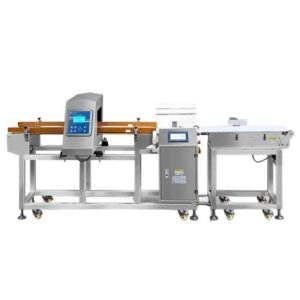
The Conveyor Metal Detector described by Foodman is intended for packaged food applications and can serve sectors including food processing, poultry, pharmaceuticals, and cosmetics. Its stated detection scope covers ferrous, non-ferrous, and stainless steel contaminants, illustrating how one inspection platform can address several material categories across different production environments.
OEM/ODM Customization and B2B Support
Foodman Vision offers OEM and ODM services for food metal detector systems. This means the equipment can be adapted to a customer’s specific production line. Aperture size, conveyor width, reject mechanism, and control panel can all be customized. For products with special packaging or high line speeds, these adjustments help maintain stable detection performance.
For B2B buyers, customization also covers software and data output. Inspection parameters can be saved for multiple products, and results can be exported for quality records. Sample testing before purchase allows manufacturers to verify detection sensitivity with their own products and packaging.
After installation, Foodman Vision provides technical support, spare parts, and operator training. This service-oriented approach helps food manufacturers keep their inspection systems running reliably over time.
Making Packaged-Product Inspection More Practical
Reliable metal detection depends on the relationship between technology and the product passing through it. Food metal detector performance is influenced by contamination type, food composition, packaging, line speed, detector configuration, and verification practices. Treating these factors as interconnected variables gives processors a clearer basis for establishing realistic inspection procedures.
Foodman Vision supports this kind of practical inspection through OEM and ODM cooperation. Equipment layout, detection parameters, and data output can be adjusted around a customer’s actual products and line conditions. For B2B buyers, this means the metal detector can be configured to fit existing conveyor systems, packaging formats, and quality procedures rather than forcing the production line to adapt to a fixed machine.
Sample testing before delivery helps confirm detection performance with real products. After installation, technical support, spare parts, and operator guidance help maintain consistent operation over time. The goal is not simply to add a metal detector to the line, but to build an inspection setup that works reliably within the broader production environment.