
Multi-trade contractors often need one machine to support several activities across a project, from moving pallets of materials to positioning loads at elevated work areas. Choosing equipment for these varied tasks requires more than comparing lifting capacity or maximum height. A rotating telehandler can offer flexible load placement, but buyers must assess jobsite layout, attachment requirements, operator training, and utilization across trades before committing to a purchase. The objective is to select a machine that improves material handling without adding unnecessary cost or operational complexity.
Identify the Tasks Across Different Trades
A contractor managing structural work, mechanical installation, façade construction, and general material handling may face different lifting requirements throughout the project. One trade might need to move heavy pallets, while another needs to place components at elevation or access areas beyond a building’s immediate perimeter. Procurement teams should list these recurring tasks before selecting a machine.
A conventional telehandler is often suitable for straightforward lifting and placement. A rotating model adds a turntable that allows the boom and upper structure to rotate, expanding the working area without requiring the chassis to be repositioned for every placement. This can be valuable on congested sites where repeated repositioning consumes time or conflicts with other equipment.
However, rotation alone does not guarantee that one machine can handle every trade’s requirements. Buyers should compare load weights, placement distances, required heights, and working clearances for representative tasks. A rotating telescopic handler should be selected according to its rated load chart and permitted operating configuration, not simply its headline lifting capacity.
Match Reach and Capacity to the Work
Maximum working height is an important specification, but it should be assessed alongside horizontal reach and load capacity at different boom positions. Telehandler capacity generally changes as the boom extends and rises. A machine that can lift a specified load near the chassis may not be rated to carry that same load at maximum outreach.
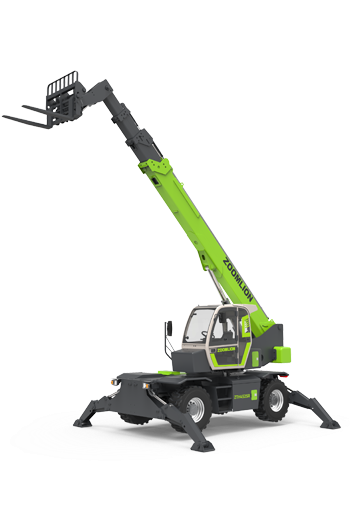
The Zoomlion Access ZTH4525R is a rotating telehandler with a maximum working height of 24.8 meters and a rated load capacity of 4,500 kg. These figures provide a starting point for contractors comparing equipment for high-level material placement and demanding lifting operations. The published maximum values should not be interpreted as a guarantee that the machine can lift 4,500 kg to its maximum working height.
Before purchasing, contractors should review the manufacturer’s load charts for the intended lifting positions. They should also consider the dimensions of the loads, pallet or attachment weight, ground conditions, and required clearance around the placement point. These checks help establish whether the machine can perform the project’s most demanding tasks safely.
Consider Rotation and Jobsite Maneuverability
The main advantage of a rotating machine is its ability to serve a wider working area from a single setup. This may reduce chassis repositioning when several trades need materials delivered to different points around a structure. On projects with limited access, fewer repositioning movements can also simplify coordination with delivery vehicles, lifting equipment, and workers on the ground.
The ZTH4525R provides 360-degree continuous rotation, allowing the upper structure to turn through a full circle. Its value depends on the available operating space, ground stability, and the locations from which loads must be picked up and placed. Contractors should map likely lifting positions and confirm the manufacturer’s clearance and operating requirements before deciding that rotation will improve productivity.
Site access also matters. Delivery routes, turning areas, ground-bearing capacity, gradients, and overhead obstructions can limit where the machine operates. The contractor should verify these conditions during procurement rather than assuming that a large working range eliminates access constraints.
Select Attachments for Multiple Trades
Attachment flexibility can determine whether a telehandler remains useful as project requirements change. Standard forks support palletized materials, while other approved attachments may suit different handling tasks. Buyers should identify which trades will share the machine and whether attachment changes can be managed efficiently without creating delays or introducing incompatible equipment.
The ZTH4525R comes with floating forks as standard, while a platform, bucket, boom, and other attachments are available as options. Contractors should confirm each attachment’s compatibility, rated capacity, and intended application with Zoomlion Access. Personnel-lifting platforms require specific approval and operating procedures; ordinary material-handling equipment should never be assumed suitable for lifting people.
A practical attachment plan should include storage, inspection, changeover time, and operator familiarity. Rather than purchasing every available option, contractors can prioritize attachments that serve recurring tasks and evaluate occasional needs separately. This approach helps control capital expenditure while retaining flexibility for different trades.
Evaluate Controls, Traction, and Operator Safety
Multi-trade projects can involve changing ground conditions, tight access routes, and operators with different levels of experience. Procurement teams should assess driving characteristics, visibility, control layout, and the training needed to operate the equipment safely. Clear operating procedures are particularly important when several crews share one machine.
The ZTH4525R uses hydrostatic driving and a four-wheel-drive system designed to provide traction and off-road capability. Its 10.1-inch display integrates monitoring and control functions with an entertainment interface. These features may support operation and machine monitoring, but buyers should evaluate the actual controls, safety systems, and training materials during a supplier demonstration.
The model is CE certified, providing a relevant compliance reference for applicable European markets. Contractors must still verify local regulations, operator qualification requirements, inspection schedules, and site-specific risk controls. A rotating telehandler requires trained operators who understand its load charts, stability limits, attachment procedures, and approved operating conditions.
Compare Fleet Utilization and Ownership Costs
The business case should account for purchase price, financing, maintenance, fuel, transportation, attachment costs, and expected downtime. A rotating machine may cost more than a conventional telehandler, so the additional investment should be justified by tasks that benefit from its wider working range and reduced repositioning.
Contractors should estimate how frequently different trades will need the machine and whether their schedules overlap. If several crews require it simultaneously, a single high-capacity unit could become a bottleneck despite its versatility. A fleet plan that considers task timing, alternative equipment, and service support can help avoid unnecessary delays.
Build a Purchase Decision Around Real Site Demands
For multi-trade contractors, the best equipment choice balances lifting performance, working range, maneuverability, attachment flexibility, and total ownership cost. The Zoomlion Access ZTH4525R combines a 24.8-meter maximum working height, 4,500 kg rated load capacity, and 360-degree continuous rotation. These specifications make it a candidate for projects requiring flexible material placement across multiple work areas.
Before committing to a rotating telescopic handler, procurement teams should validate demanding lift scenarios against official load charts, check attachment compatibility, and review site access and operator requirements. Matching these details to the project’s actual workload helps contractors determine whether rotating capability offers sufficient operational value to justify the investment.